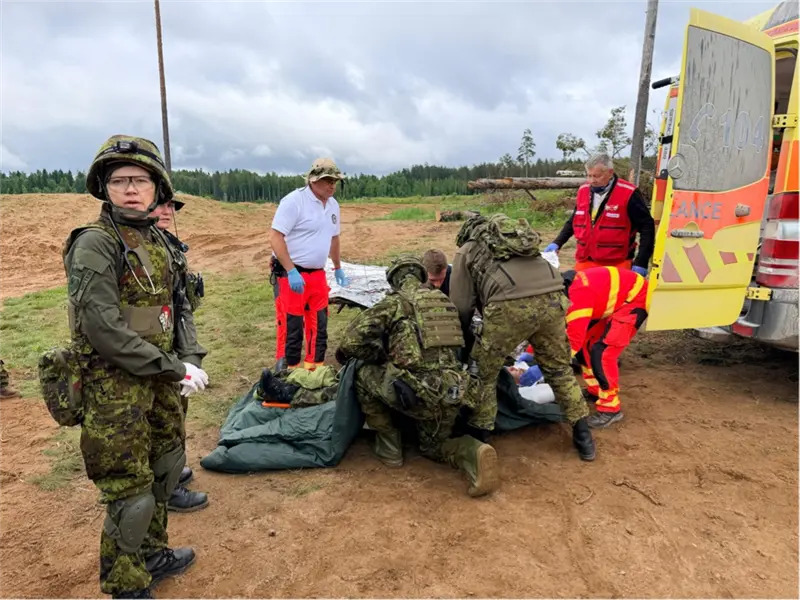
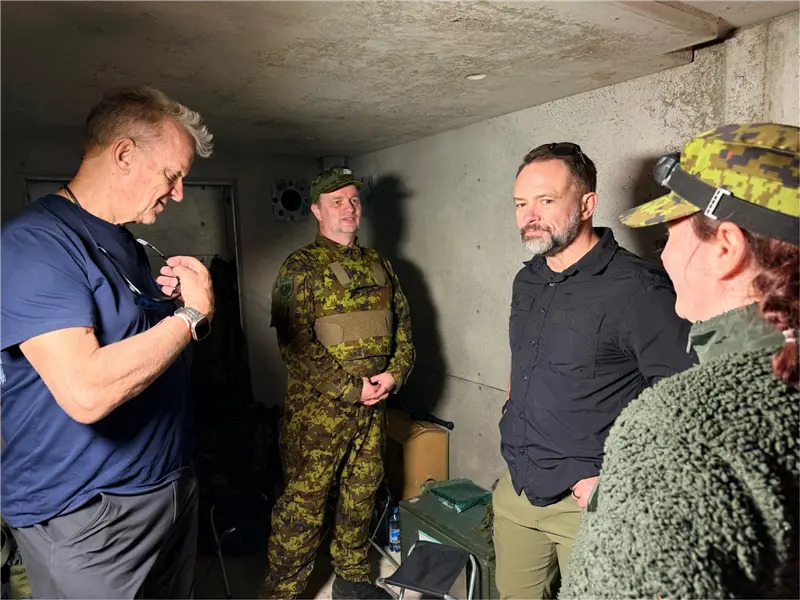
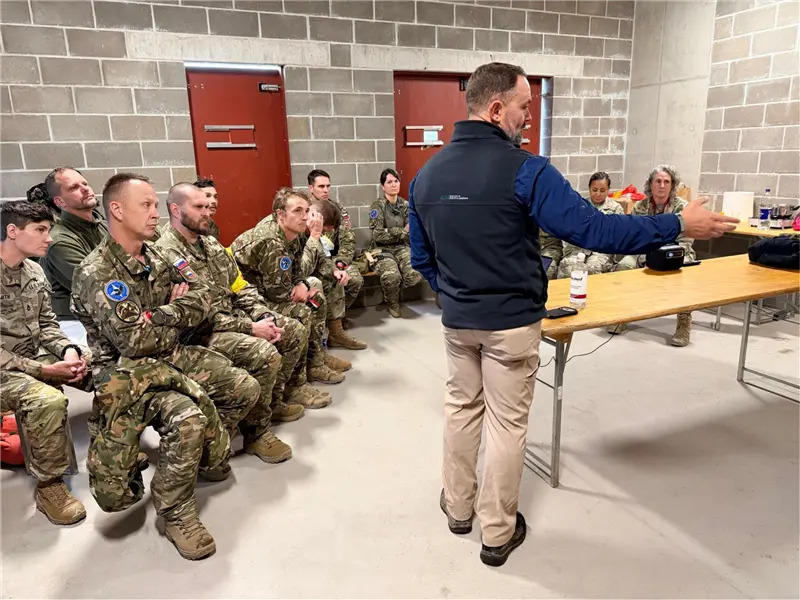
FORT SMITH, AR. — Following the announcement of Arkansas Colleges of Health Education’s (ACHE) new partnership with the NATO Centre of Excellence for Military Medicine (NATO MILMED COE) during Exercise Vigorous Warrior 2026, faculty immediately joined NATO and international partners in one of the exercise’s most timely educational initiatives—the Ukraine Lessons Learned Workshop.
At the invitation of the NATO Centre of Excellence for Military Medicine (NATO MILMED COE), ACHE faculty collaborated with World Extreme Medicine (WEM), the World Extreme Medicine Fund (WEMF), and NATO partners to develop and deliver this multinational educational program. The multidisciplinary instructional team was led by Travis Kaufman, DMSc, PA-C, FIBODM (ACHE), and included Robert Gray, DMSc, MBA, PA-C, FIBODM (ACHE); Mark Hannaford, DSc (World Extreme Medicine and Co-founder of the World Extreme Medicine Fund); Luca Alfatti, FRRHH, FEWM, FRGS, MSc (Co-founder, World Extreme Medicine Fund); Alex Gaspar (World Extreme Medicine Fund); David Stanton (University of Nottingham); and Corey Gustafson, CAPT (OF-5), MC, USN, Chief of Lessons Learned and Innovation Branch, NATO MILMED COE. Together, the instructional team presented contemporary operational lessons emerging from the war in Ukraine and facilitated multinational discussions on how those experiences are reshaping military medicine, education, and operational readiness across the Alliance. The workshop represented the culmination of several months of collaboration with NATO MILMED COE. Kaufman and Gustafson jointly led the educational planning and delivery of the Ukraine Lessons Learned program, presenting operational observations from the war in Ukraine to multinational medical leaders in advance of Exercise Vigorous Warrior. Those engagements helped shape educational content delivered during the exercise and provided participating nations with a contemporary framework for integrating evolving battlefield medical practices into training, planning, and operational readiness. Topics included prolonged casualty care, the operational impact of drone warfare, trauma stabilization points, casualty evacuation in contested environments, and medical support during large-scale combat operations. Drawing from recent operational experience, presenters facilitated discussions on how these evolving challenges are influencing military medical planning and patient care across the Alliance.

The workshop brought together military medical professionals representing 38 NATO and partner nations, providing a forum to exchange contemporary operational lessons and discuss their application across multinational military medical systems. “A primary purpose for the Vigorous Warrior exercise is to train together in a multinational environment in order to strengthen our interoperability as an alliance and thus foster readiness,” stated Corey Gustafson, CAPT (OF-5), MC, USN, Chief of Lessons Learned and Innovation Branch. “A crucial attribute of NATO is that it is a leaning organization that promotes, and in reality relies on, a collaborative approach to educating its members. At the very core of our learning is incorporating the lessons learned approach to this endeavor. Now, more than ever in our alliance’s history, has the value of incorporating contemporary lessons learned into our multinational exercise been more important. I would argue that this alone may be the singular most important thing we can do in order to truly prepare ourselves for a near-future conflict. Not doing so would be to ensure our own demise.” The educational impact extended well beyond the workshop itself. Throughout Exercise Vigorous Warrior, ACHE faculty, alongside colleagues from World Extreme Medicine and the World Extreme Medicine Fund, participated in numerous follow-on educational sessions with multinational medical teams. These engagements created opportunities for participants to discuss current operational challenges, compare multinational approaches, and immediately integrate lessons learned into exercise training and clinical decision-making. “When Luca Alfatti and I first traveled to Ukraine over four years ago, we went to teach,” said Mark Hannaford DSc FRRHH FEWM, Founder, World Extreme Medicine & Co-founder, the WEM Fund. “Today, every mission is as much about learning as it is about sharing knowledge. “The pace of change on the modern battlefield is unlike anything we’ve seen before, demanding constant innovation and adaptation from those delivering care at the point of injury. What has impressed us most is the extraordinary resilience, ingenuity and determination of the Ukrainian frontline medical community. They have not only adapted to this reality but are helping redefine modern battlefield medicine. “Through our partnership with NATO, World Extreme Medicine and The WEM Fund have an opportunity to ensure those hard-earned lessons are shared internationally. If military medicine is to remain relevant, it must be agile enough to evolve as quickly as the battlefield itself. Ultimately, that agility will save lives.” “The value of lessons learned isn’t in documenting them, it’s in applying them before the next casualty arrives,” said Travis Kaufman, DMSc, PA-C, FIBODM, Director of the Doctor of Executive Leadership Program at ACHE. “Over the past several months, we’ve had the privilege of working alongside NATO and our international partners to share contemporary operational lessons from Ukraine before Exercise Vigorous Warrior ever began. This wasn’t simply a workshop; it was part of an ongoing multinational conversation about how we prepare medical teams for the realities of modern conflict. When we shorten the time between operational experience and education, we improve readiness across the Alliance and ultimately improve patient outcomes.”
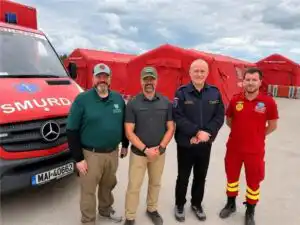
Robert Gray, DMSc, MBA, PA-C, FIBODM, Associate Program Director, Doctor of Medical Science, said, “Exercise Vigorous Warrior was a unique opportunity for military and civilian medical teams to not only practice integration of their systems, but to learn lessons from each other. Every time I turn on the news, I see disaster and conflict. Through these, we see the immediate impact of trained and prepared professionals and their ability to care for patients no matter where they are. From the civilian ambulance teams to the military combat medics, all the way to the improvised field hospitals, we witnessed incredible focus, courage, innovation, and a hunger for continued teaching and learning. Participants in the exercise, no matter their nation or culture, will be ready to share their hard-won lessons in their home units, ultimately bringing us all closer together in practice.” The success of the workshop reflected the strength of collaboration among academic institutions, military organizations, and non-governmental partners. ACHE recognizes the leadership and contributions of Corey Gustafson and the NATO MILMED COE team, together with Mark Hannaford, Luca Alfatti, Alex Gaspar, and David Stanton, whose partnership and expertise helped plan, deliver, and expand the multinational educational programming conducted throughout Exercise Vigorous Warrior. As military medicine continues to evolve in response to emerging threats, partnerships that connect operational experience with education become increasingly valuable. The Ukraine Lessons Learned Workshop demonstrated how collaboration across organizations and nations can rapidly translate real-world experience into practical knowledge that strengthens medical readiness, enhances interoperability, and ultimately improves patient outcomes. By helping lead the development and delivery of multinational education before and during Exercise Vigorous Warrior, ACHE continues to strengthen its role as a trusted academic partner supporting NATO and allied organizations, advancing executive education, military medical readiness, and the global exchange of operational knowledge.