
Arkansas Colleges of Health Education (ACHE) participates in the Federal Direct Loan Program. Eligible students may borrow Federal Direct Loans to help pay educational expenses while enrolled. The U.S. Department of Education is the lender for all Federal Direct Loans.
Federal student loans accrue interest, may be subject to origination fees, and must be repaid according to the terms of the promissory note. Additional information is available at StudentAid.gov.
Federal Direct Loans
Graduate and professional students may be eligible to borrow the following types of Federal Direct Loans:
- Federal Direct Unsubsidized Loans
- Federal Direct Graduate PLUS Loans* (available only to borrowers who meet the federal interim exception requirements described below)
Federal Direct Unsubsidized Loans
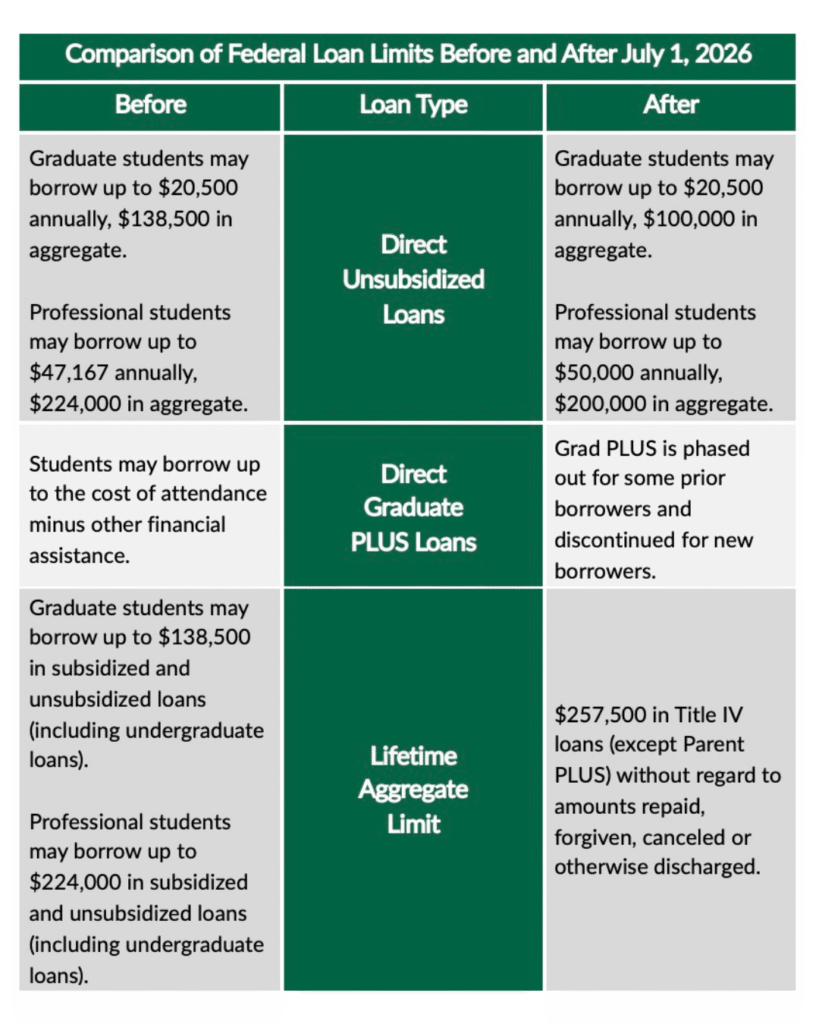
Federal Direct Unsubsidized Loans are subject to annual, aggregate, and lifetime borrowing limits established by federal law. Loan eligibility may not exceed the student’s Cost of Attendance (COA), as determined by ACHE, minus all other financial assistance received.
Limits before July 1, 2026
Graduate Students:
- Annual Limit: $20,500
- Aggregate Limit: $138,500 (includes undergraduate borrowing)
Professional Students:
- Annual Limit: up to $47,167
- Aggregate Limit: $224,000 (includes undergraduate borrowing)
Changes Effective July 1, 2026
Graduate Students:
- Loans must be prorated based on enrollment status
- Annual limit remains $20,500
- Aggregate limit: $100,000 (excludes undergraduate borrowing)
Professional Students:
- Loans must be prorated based on enrollment status
- Annual limit: $50,000
- Aggregate limit: $200,000 (combined graduate and professional direct loans)
Lifetime Maximum Loan Limit: $257,500
This limit includes all loans received as an undergraduate, graduate, or professional student under the Direct Loan Program and the Federal Family Education Loan (FFEL) Program, including graduate or professional PLUS loans borrowed by the student.
It does not include Parent PLUS Loans, consolidation loans (although the underlying loans are counted), or Health Education Assistance Loan (HEAL) or other health profession program loans.
All eligible loans count toward the limit regardless of repayment status, including amounts that have been repaid, forgiven, canceled, or discharged.
Once a borrower reaches the $257,500 lifetime maximum aggregate loan limit, they are no longer eligible to receive additional federal student loans, even if previous loans have been repaid, forgiven, canceled, or discharged.
Borrowers who qualify for a temporary federal interim exception may exceed the limit during the exception period; however, the total borrowing remains tracked and the limit will apply once the exception ends.
Interest Rate
- The Direct Unsubsidized loan has a fixed interest rate set based on the date of first disbursement. A new interest rate is established each July 1. Visit StudentAid.gov to view the present interest rate.
- Interest begins to accrue at the time of disbursement and continues during enrollment and repayment.
Loan Origination Fee
- The Direct Unsubsidized loan has an origination fee set based on the date of first disbursement. A new origination fee is established each October 1. Visit StudentAid.gov to view the present origination fee.
Repayment
- Most borrowers receive a six-month grace period before repayment begins after graduating or dropping below half-time enrollment.
Additional Information
- No credit check is required.
- View our Apply for Financial Aid page for instructions on applying.
- View more loan details at StudentAid.gov.
Federal Direct PLUS Loans*
(Available only to borrowers who meet the federal interim exception requirements described below.)
Annual Amount
The maximum loan amount is limited to the Cost of Attendance, less any other financial assistance awarded, including loans and scholarships.
Interest Rate
- The Direct PLUS loan has a fixed interest rate set based on the date of first disbursement. A new interest rate is established each July 1. Visit StudentAid.gov to view the present interest rate.
- Interest begins to accrue at the time of disbursement and continues during enrollment and repayment.
Loan Origination Fee
- The Direct PLUS loan has an origination fee based on the date of first disbursement. A new origination fee is established each October 1. Visit StudentAid.gov to view the present origination fee.
Repayment
- Repayment begins within 60 days after the final disbursement of the loan. Borrowers may request deferment while enrolled at least half-time in an eligible program.
- Borrowers must request post-enrollment deferment from their loan servicer after the student graduates or ceases to be enrolled at least half-time.
Additional Information
- A credit check is required. If a student does not pass the credit check, the borrower may have the option to appeal or obtain an endorser.
- No lifetime aggregate borrowing limit.
- View our Apply for Financial Aid page for instructions on applying.
- View more loan details at StudentAid.gov.
*Only available to students who meet the federal interim exception criteria that allow for the continuation of pre–July 1, 2026, loan limits and eligibility. To qualify, a student must have been enrolled in the program of study at ACHE as of June 30, 2026, must have had a Direct Loan disbursed for that program prior to July 1, 2026, and must remain continuously enrolled in the same program of study at ACHE without a break in enrollment. This interim exception permits continued borrowing for the lesser of three academic years or the remaining expected time to credential.
Students who do not meet these criteria are not eligible to receive Graduate PLUS Loans for periods of enrollment beginning on or after July 1, 2026, and must rely on Direct Unsubsidized Loans and, where applicable, private student loans.
Direct Loan Requirements
Entrance Counseling
First-time Federal Direct Loan borrowers at ACHE must complete Entrance Counseling before loan funds can be disbursed. Entrance Counseling is available at StudentAid.gov.
Master Promissory Note
Federal Direct Loan borrowers must complete a Master Promissory Note (MPN) before loan funds can be disbursed. The MPN is available at StudentAid.gov.
Exit Counseling
Federal Direct Loan borrowers must complete exit counseling when they graduate, withdraw, or drop below half-time enrollment. Exit counseling is available at StudentAid.gov.
Repayment
Federal student loans must be repaid in accordance with the terms of the promissory note and federal regulations. Multiple repayment plans and borrower protections, including deferment and forbearance, may be available through StudentAid.gov.
Federal Student Aid Feedback System
Students may file a complaint, report suspicious activity, or provide positive feedback via the FSA Feedback System.
Private Student Loans
Private education loans may be an option for students who need additional funding beyond their federal financial aid eligibility. Private loans, sometimes referred to as “alternative loans,” are offered by private lenders and may help students cover educational expenses up to the Cost of Attendance, less any other financial aid received.
Consider Federal Loans First
Private student loans are not federal student loans and do not offer the same repayment options, borrower protections, or benefits. Because federal loan terms are often more favorable, students are encouraged to exhaust their federal student loan eligibility before applying for a private loan. Students are encouraged to review the Department of Education’s information on Federal Versus Private Loans.
Compare Your Options
ACHE provides the FASTChoice tool to help students review and compare private education loan options, including historical lender information and disclosures required under the Truth in Lending Act (TILA).
Required Self-Certification
Federal regulations require private education loan borrowers to complete a Private Education Loan Applicant Self-Certification form provided by their lender. The Office of Financial Aid can assist students in obtaining the information needed to complete this form.
Lender Choice
ACHE does not maintain a preferred lender list and does not endorse or recommend any specific lender. Students are free to borrow from the private lender of their choice.